This collaborative project by Australian weaver Liz Williamson explores local colour, cultural connections, and shared weaving traditions. It extends from Williamson’s research into experiments with Australian natural dye plants and unique colours extracted from locally sourced plants. The project features 100 panels woven by Williamson with fabric dyed by 60 collaborators with over 50 eucalypts species identified and sourced from over 50 locations.
In 2020, Williamson began inviting colleagues in Australia and India to colour silk fabric with eucalyptus leaves collected locally. Once received in her studio, the fabric was stripped and woven into panels referencing the traditions of woven rag rugs and ‘making do’ where ‘new’ items are made from old or readily available materials. In this project, the fabric is new while the colour is readily available in eucalyptus leaves, bark, and twigs. The woven panels reflect place and location while the process has created a unique community of practitioners.
Since 2021, the project has expanded to connect with more colleagues in Australia and India as well as other countries touched by the Indian Ocean – Bangladesh, Indonesia, Malaysia, Pakistan, Sri Lanka, South Africa, and Thailand.
Touring Venues
Wangaratta Art Gallery, VIC
23 February – 14 April 2024
Performance Arts Culture Cessnock, NSW
15 December 2023 – 4 February 2024
Tamworth Regional Gallery, NSW
25 August – 15 October 2023
Ararat Gallery – Textile Art Museum Australia, VIC
4 March – 18 June 2023
Castlemaine Art Museum, VIC
15 September 2022 – 12 February 2023
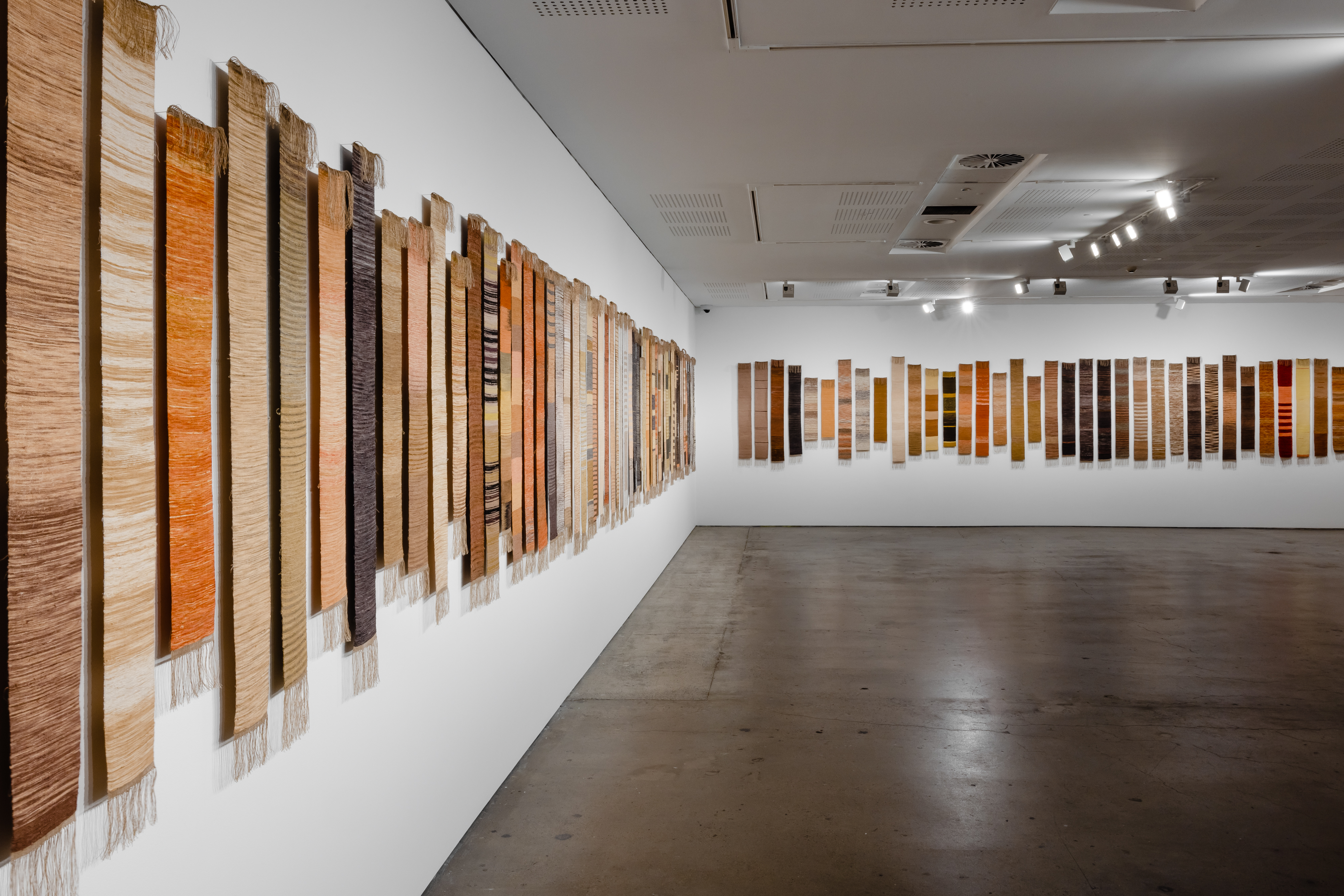
Installation view, ‘Liz Williamson: Weaving Eucalypts Project’, UNSW Galleries, 2022.
Photograph: Jacquie Manning.

Installation view, ‘Liz Williamson: Weaving Eucalypts Project’, UNSW Galleries, 2022.
Photograph: Jacquie Manning.


Image
Liz Williamson, 'Weaving Eucalypts Project' (detail) 2020-2021. Silk dyed by artists in Australia, India and Bangladesh with locally sourced eucalyptus leaves, bark or twigs; silk hand woven as weft into a linen and cotton warp.
Photograph: John Hobbs