Archie Moore
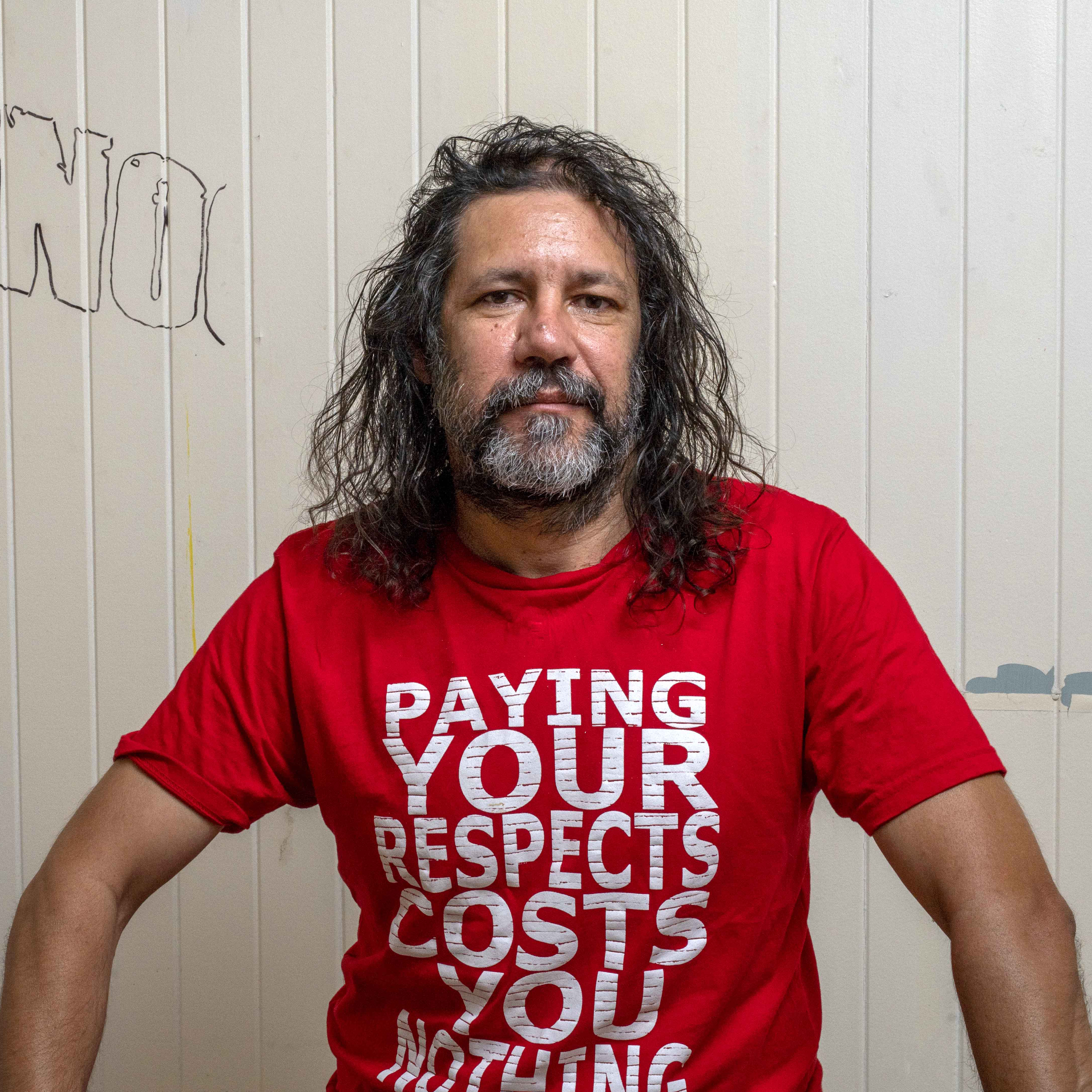
Archie Moore (b. 1970, Toowoomba, Queensland; l. Meanjin/Brisbane, Australia) is a Kamilaroi/Brisbane artist working across media in portrayals of self and national histories.
His ongoing interests include key signifiers of identity – skin, language, smell, home, flags – as well as the borders of intercultural understanding and misunderstanding, and the wider concerns of racism. Uncertainty is an ongoing theme pertaining to his paternity and Kamilaroi heritage. Selected exhibitions include Archie Moore – Kith and Kin: the 60th Biennale de Venezia , (2024); Embodied Knowledge: Queensland Contemporary Art, (2022-2023), Queensland Art Gallery, Brisbane; Dwelling, Gertrude Contemporary, Melbourne, (2022); Mīal, The Commercial, Sydney, (2022); Un/Learning Australia, Seoul Museum of Art, Seoul, (2022); The Colour Line, UNSW Gallery, Sydney (2021); and Arch Moore 1970 – 2018, Griffith University Art Museum, Brisbane (2018).
Archie Moore is represented by The Commercial, Sydney.

Archie Moore, Family Tree 2021.
Installation view, ‘The Colour Line: Archie Moore & W.E.B Du Bois’, UNSW Galleries, 2021.
Photograph: Zan Wimberley

Archie Moore, Family Tree 2021.
Installation view, ‘The Colour Line: Archie Moore & W.E.B Du Bois’, UNSW Galleries, 2021.
Photograph: Zan Wimberley

Archie Moore, Graph of Perennial Disadvantage, 2021.
Installation view, ‘The Colour Line: Archie Moore & W.E.B Du Bois’, UNSW Galleries, 2021.
Photograph: Zan Wimberley
Graph of Perennial Disadvantage 2021
Paint on handmade paper
Family Tree 2021
Conté on blackboard paint on Valchromat panels
Courtesy of the artist and The Commercial, Sydney
Presented in the exhibition 'The Colour Line: Archie moore & W.E.B Du Bois', at UNSW Galleries.
The exhibition project, ‘The Colour Line: Archie Moore & W.E.B Du Bois’ premiered the first artwork supported by the UNSW Galleries Commissioners Circle, whose contribution is attributed to two major works by Archie Moore, the ‘Graph of Perennial Disadvantage’ 2021, and ‘Family Tree’ 2021.
Family Tree 2021
After conducting further research into his paternal history, Archie Moore updates his ‘Family Tree’, 2018–21 wall drawing which was first exhibited as a site-specific installation in ‘Archie Moore: 1970 –2018’ at Griffith University Art Museum, Brisbane. Recreated at UNSW Galleries, this hand-drawn sprawling chalkboard style genealogy complicates historical diagrams drawn up by anthropologists. Beginning with a box enclosing ‘me’, the descent-line record reaches back thousands of years from known named people to those recorded in terms such as ‘Full-blood Aboriginal’, and those existing only as numbered individuals.
Family Tree, 2021 was later acquired by the National Gallery of Australia and subsequently expanded for the Kith and Kin exhibition at the 2024 Venice Biennale, where it earned the prestigious Golden Lion for Best National Presentation.
Graph of Perennial Disadvantage 2021
For ‘The Colour Line’, exhibition curator and UNSW Galleries Director José Da Silva invited Archie Moore to create a new commission responding to W.E.B Du Bois’ data portraits of African American social progress in the United States c. 1900. Moore’s new commission ‘Graph of Perennial Disadvantage’ 2021, responded to 120 years of Australian political history and the lack of agency afforded to Aboriginal and Torres Strait Islander people.
The work was created with decommissioned volumes of Hansard, the printed record of Australia’s parliamentary proceedings. Moore has previously used these documents to create sculptures that emphasise how those in power have debated Aboriginal affairs endlessly without much action. In this new work, they were pulped and reformed into a large sheet resembling government-issued blankets distributed to Aboriginal people in Queensland during the 1880s.
The bars that constitute the ‘graph’ reflected the design of blankets preserved at the Queensland Museum. On the reverse, signifiers of the crown’s property are a reminder of the object’s use in monitoring and controlling Aboriginal populations. The annual gifting of blankets was often a pretence for the exchange of land, resources, and bodies – and in some instances, for the introduction of smallpox. For Moore, these blankets represent the minimum amount of care you can give someone: “the gifting of an object – that you can’t ever actually own – to someone you have brutalised, which may comfort you superficially or may kill you.”