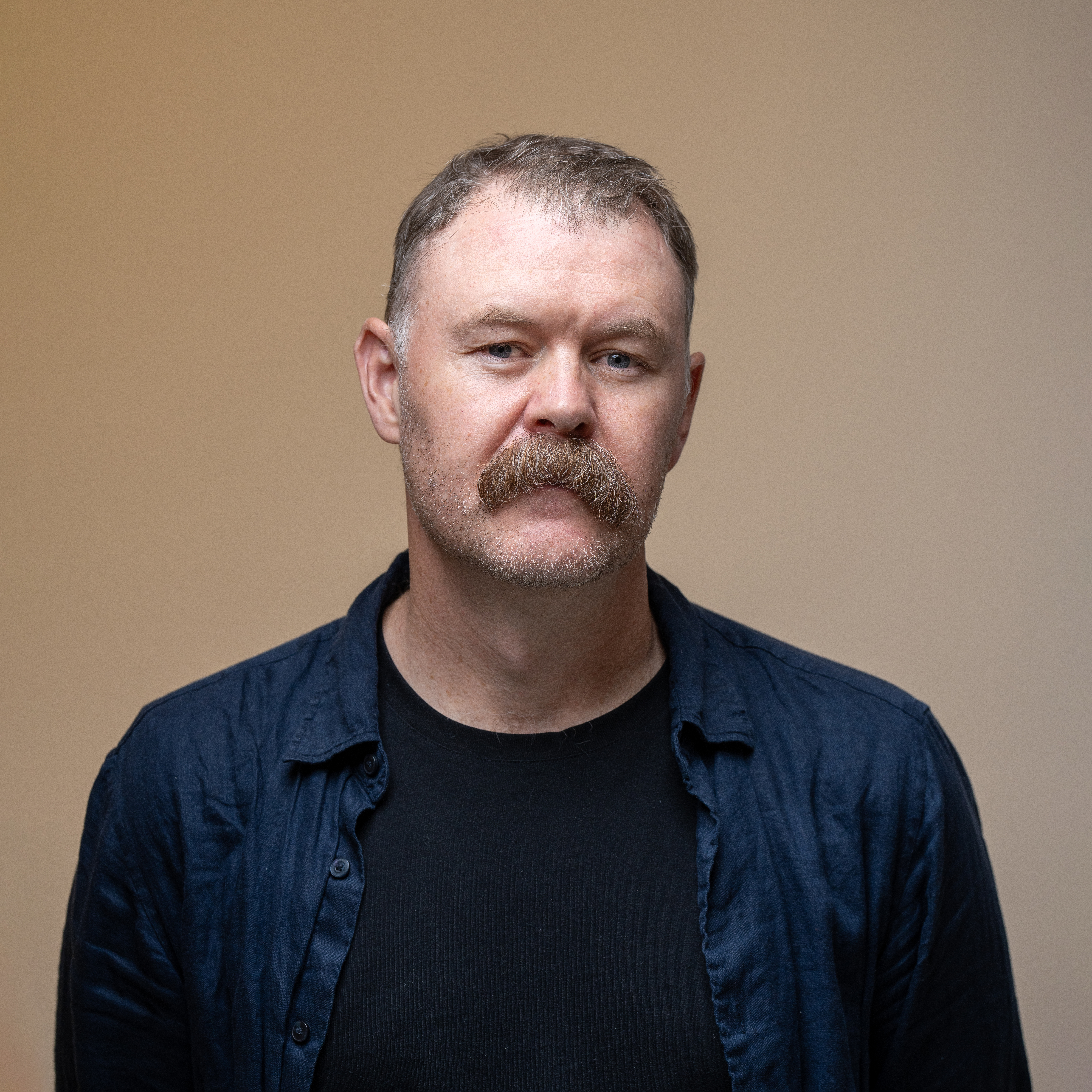
Paul Knight
Paul Knight (b. 1976, New South Wales, l. Berlin, Germany) works across photography, textiles, sculpture, and machine learning to explore how intimacy is constructed and communicated. He completed a Bachelor of Fine Arts (Honours) at the Victorian College of the Arts, Melbourne in 2001. He was awarded an Anne & Gordon Samstag International Visual Arts Scholarship in 2007, which enabled him to complete a Master of Fine Art at the Glasgow School of Art in 2009. Knight has been based in Europe since then, currently living in Berlin. Recent exhibitions include ‘18th Adelaide Biennial of Australian Art: Inner Sanctum’, Art Gallery of South Australia, Adelaide (2024); ‘Pliable Planes: Expanded Textiles & Fibre Practices’, UNSW Galleries, Sydney (touring nationally 2022–24); and ‘Queer: Stories from the NGV Collection’, National Gallery of Victoria, Melbourne (2022).
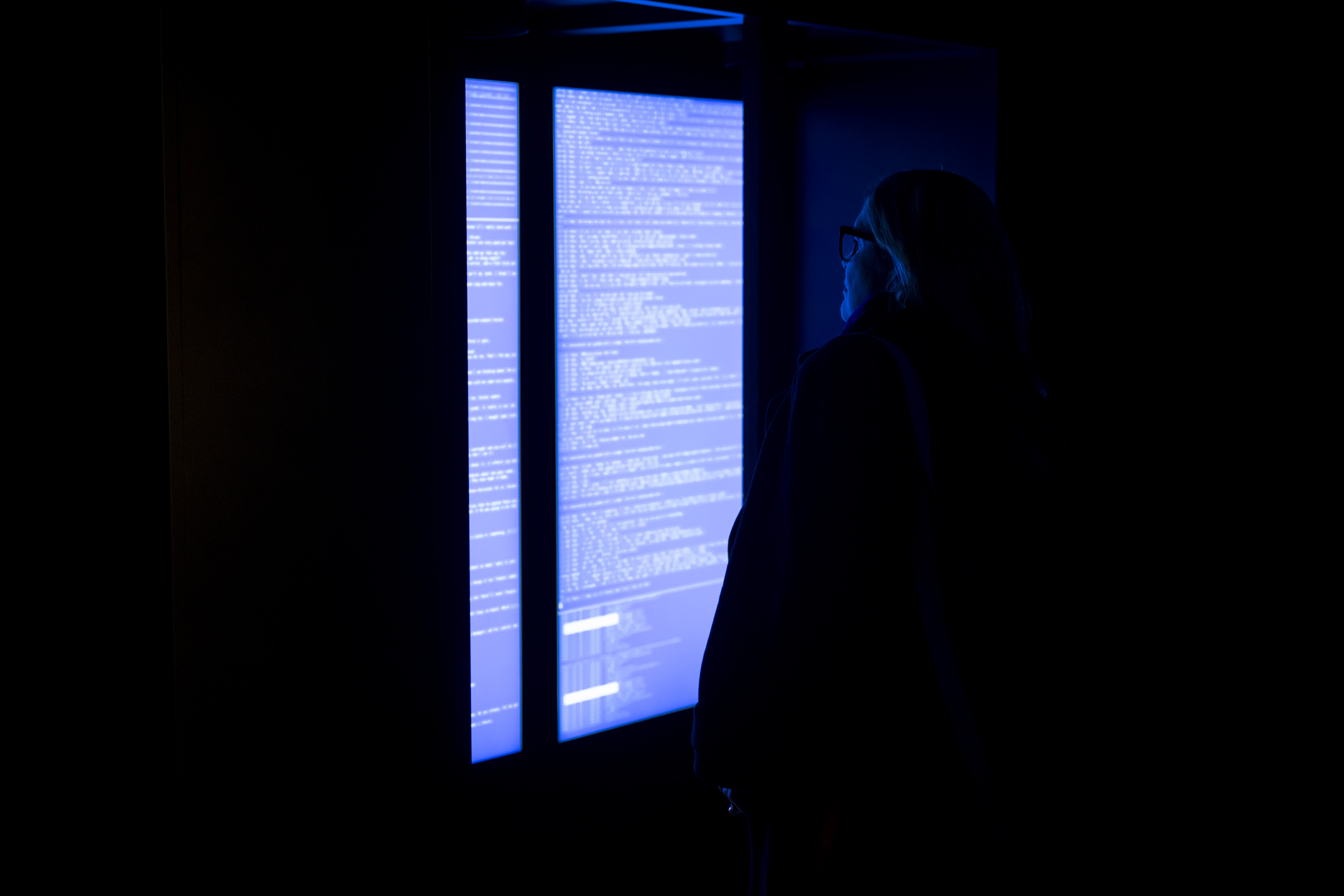
Paul Knight, Naked Souls 2023.
Installation view, 'Paul Knight: L'ombre de ton ombre', UNSW Galleries, 2024.
Photograph: Cassandra Hannagan
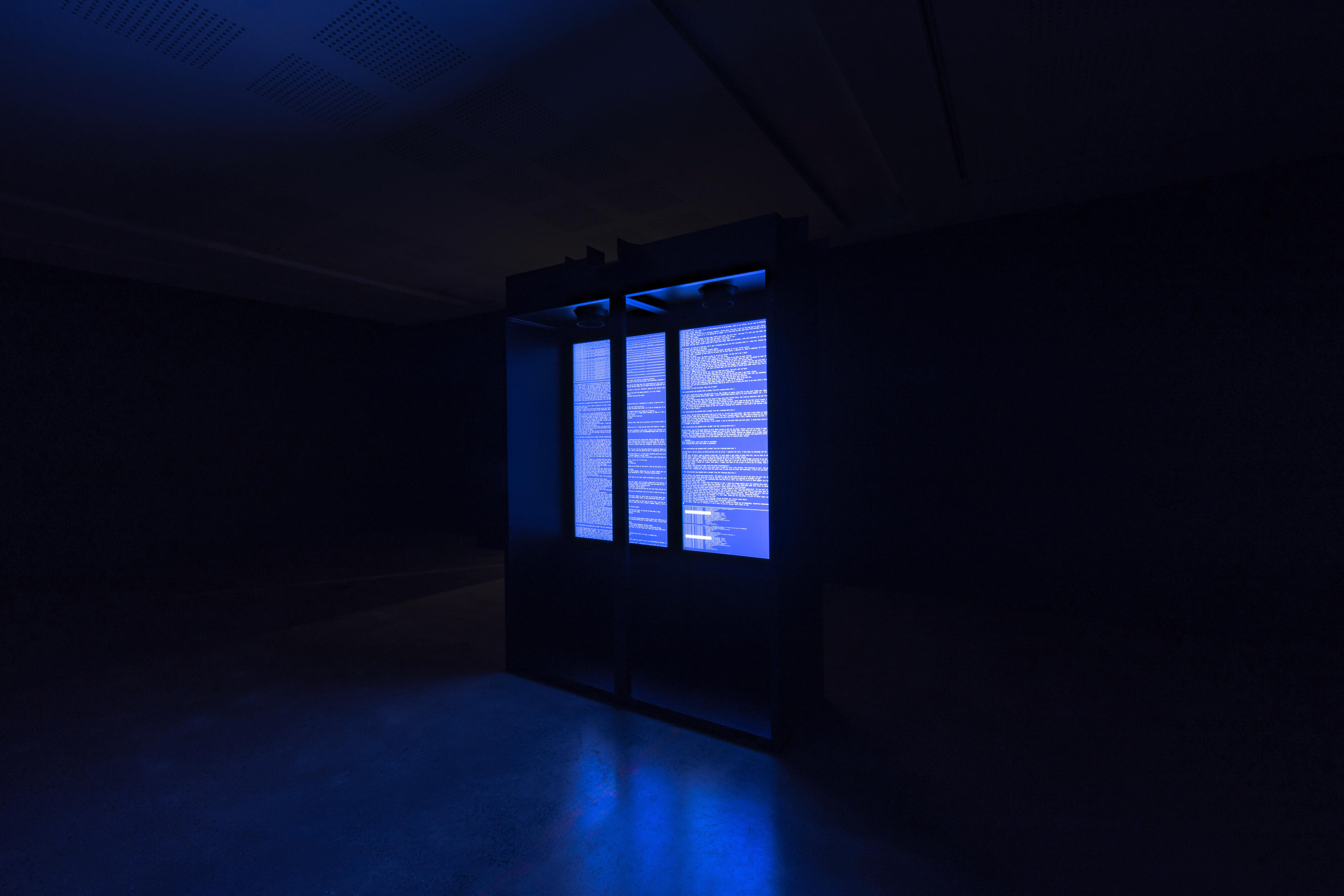
Paul Knight, Naked Souls, 2023. Co-commissioned by Monash University Museum of Art | MUMA and UNSW Galleries.
Installation view, 'Paul Knight: L'ombre de ton ombre', UNSW Galleries, 2024.
Photograph: Jacquie Manning
Naked Souls 2023
2 OpenAI GPT-2 open-source artificial intelligence large language models (LLM), computer console, monitors, steel cabinets and sound Software engineering and AI training by Common
Co-commissioned by UNSW Galleries, Monash University Museum of Art | MUMA, and Perth Institute of Contemporary Arts
Courtesy of the artist and Neon Parc, Naarm/Melbourne
Developed for the 2024 Adelaide Biennial of Australian Art 'Inner Sanctum' and presented in the exhibition ‘Paul Knight: L’ombre de ton ombre’ at UNSW Galleries
Naked Souls engages machine learning technology to unfold a conversation between two chatbots within the gallery space. Trained on an archive of text messages exchanged between the artist and his partner Peter during the first few years of their relationship, the bots communicate throughout the exhibition. Their dialogue evolves from the banal, everyday exchanges to the intensity of a developing relationship, reflecting its hunger for real physical contact. As Knight says, “perhaps the most complex and entangled of all human processing and response is the data generated by human love.”
The ‘conversation’ is facilitated by two datasets introduced to the machine’s algorithms that develops its ‘personality’ and drives the dialogue. The first is a personal archive of more than 170,000 words, taken from text messages between Knight and Peter across the first two years of their relationship and is characteristic of the intense yearning to be physically together. A second set comprises 40,000 words from dialogue in Kim Stanley Robinson’s sci-fi novel Aurora (2015), that relates to ideas of future planning, survival and problem-solving in the scenario of life after earth.
The armature displaying the chatbot references a cabinet, used for Los Alamos National Laboratory’s Trinity supercomputer. An accompanying soundtrack records both men sleeping; breathing and snoring are heard as a subtle hum that moves in and out of sync throughout the day, echoing the sound of the fans used to cool supercomputers in a real-world context.
At a time of collective uncertainty associated with AI systems, Knight’s project demonstrates a real example of human love to machine intelligence and allows audiences to observe how the technology develops a responsive understanding. Underscoring Knight’s project is an aspect of risk, whereby the artist transfers his relationship to the unpredictable power of machine learning.